

The ability to prioritize is a skill, and like all skills, it can be developed. When you learn to prioritise effectively, you’ll not only gain more control over your time, but you’ll also be able to produce higher-quality results in the areas that truly count.
What You Don’t Do Defines What You Achieve
So often, we find ourselves saying yes to everything—whether it’s work-related responsibilities, personal favours, or small, seemingly urgent tasks. Yet, by spreading ourselves too thin, we dilute our effectiveness. The truth is, you can’t do it all, and the sooner you accept that, the more empowered you’ll feel. The true challenge isn’t in getting everything done, but in intentionally deciding what to let go of.
When you don’t actively set priorities, you allow others to dictate your time. Their urgencies become your distractions, steering you away from what truly matters to your long-term goals. Prioritising isn’t about fitting more into your day—it’s about focusing on what moves you toward your goals, while consciously deciding what can wait or be eliminated.
One of the most powerful steps in setting priorities is learning how to say no. When you don’t set boundaries or say yes to too many things, you surrender control of your time. Your schedule becomes filled with tasks that others deem important, but which may not align with your long-term goals. Saying no isn’t about being selfish—it’s about valuing your own time and priorities.
By declining tasks that don’t move you forward, you’re opening up space to invest in the things that truly matter to you. You’re giving yourself permission to focus on what brings value, both to your career and to your personal life.
The Eisenhower Matrix: A Simple Tool for Clear Priorities
One of the most effective tools for prioritization is the Eisenhower Matrix, a framework that helps you categorize tasks based on urgency and importance. Named after President Dwight D. Eisenhower, who famously said, “What is important is seldom urgent, and what is urgent is seldom important,” this matrix is a visual way to separate tasks that demand your immediate attention from those that are less critical.
Dividing tasks into four categories
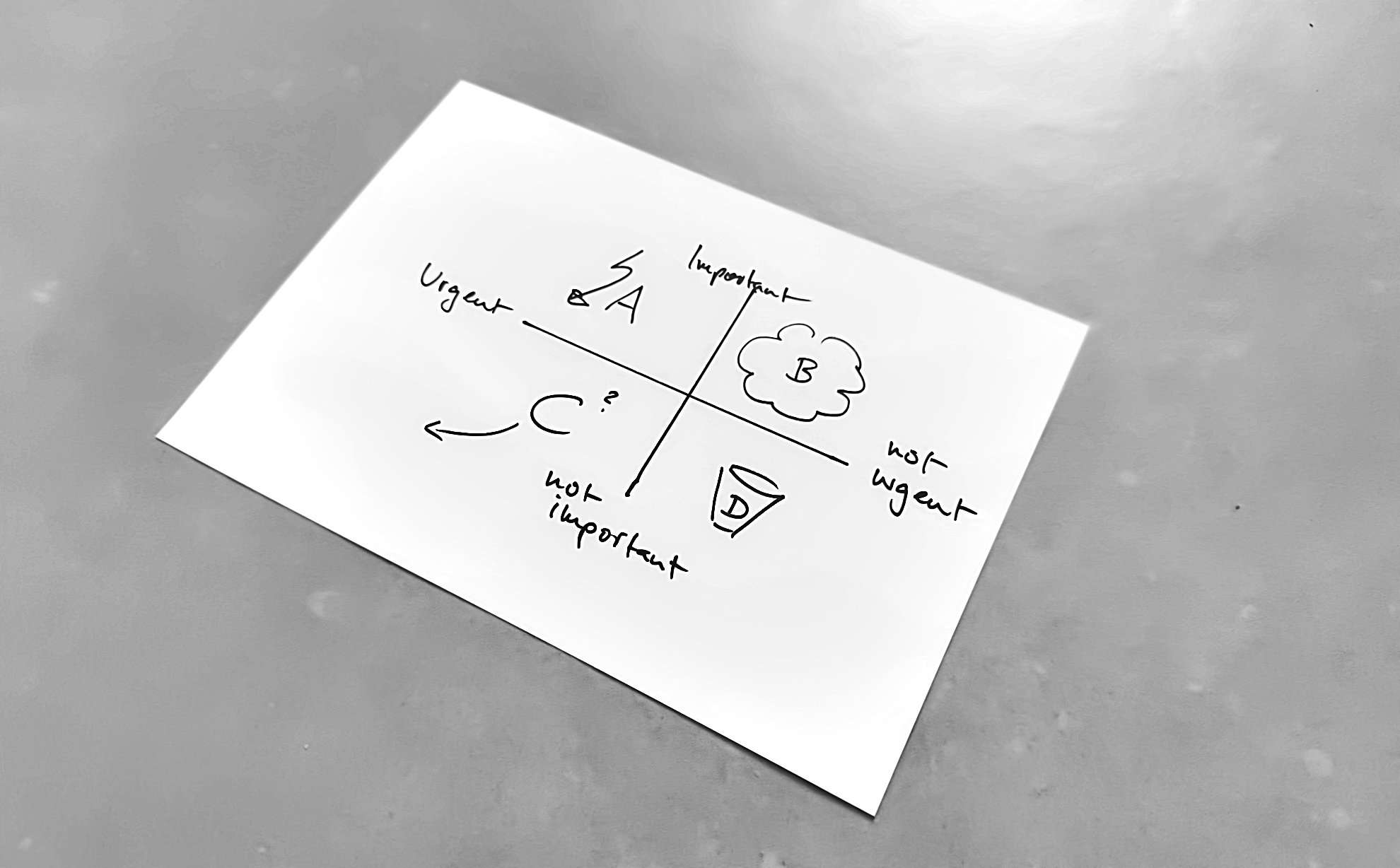
– A –
Important
and Urgent
These are the critical tasks that require immediate attention and contribute to your long-term goals.
Ask yourself, “What will happen if this isn’t done today?” If the consequences are serious and the task aligns with your key goals, it belongs here. Examples include meeting a critical deadline or addressing an emergency.
– B –
Important
but Not Urgent
These tasks are vital to your future success but don’t need immediate action. This category holds your highest-priority work.
Often related to planning, long-term projects, and personal growth. If a task contributes to your future success but doesn’t have an immediate deadline, place it in this category. Think of strategic planning, relationship-building, or developing a new skill.
– C –
Not Important
but Urgent
These tasks often involve other people’s demands but don’t align with your own strategic objectives. They can usually be delegated or minimized.
If something is time-sensitive but doesn’t directly support your core objectives, it falls here. Consider delegating these tasks if possible, or handle them only after high-priority tasks are complete. Examples include scheduling meetings or responding to non-essential emails.
– D –
Not Important
and Not Urgent
These tasks don’t add value and can often be eliminated.
Many people spend most of their day on these tasks: it looks a lot like busywork, but won’t support you in pushing you toward your goals. If it doesn’t contribute to your success or well-being, and there’s no rush to complete it, eliminate or ignore it. Think of excessive social media scrolling or unnecessary meetings.
By sorting tasks into these categories, you’ll quickly see where your focus should lie. The real power is found in focusing on the second quadrant: important but not urgent. This is where your long-term vision takes root and grows.
While the Eisenhower Matrix is a great starting point, there are other tools that can support you in getting more vital tasks done. Here are three that I personally like a lot for keeping me productive:
- The Pareto Principle (80/20 Rule): This rule states that 80% of your outcomes come from 20% of your efforts. Identify which 20% of tasks yield the greatest impact and make those your top priority.
- Time Blocking: Schedule specific blocks of time for high-priority tasks and make those periods non-negotiable. During these blocks, focus entirely on what matters most, ensuring that distractions are minimized.
- Pomodoro Technique: Break work into intervals that cannot be interrupted except in an emergency, followed by a 5-minute break in which you can react to the interruptions that happened in the meantime. This way you can work without being constantly distracted, giving priority to the task you’re working on.
A 7-Steps Guide to focus on what really matters
Clarify Your Goals
The first step in setting priorities is to define your overarching life or career goals.
What are you aiming for in the long term? What projects or personal aspirations do you want to accomplish?
Understanding what truly matters to you will serve as a compass for prioritizing your daily tasks.
List All Tasks and Responsibilities
Write down everything currently demanding your attention—no matter how small and from which part of your life.
This could include work-related tasks, personal obligations, and even daily routines.
Having a full view of your responsibilities will help you see what’s pulling your focus in different directions.
Sort Tasks Using the Eisenhower Matrix
Once you have your list, use the Eisenhower Matrix to categorize each task.
Be honest with yourself about what’s truly important and what can be postponed, delegated, or even ignored.
Remember, not everything needs to be done.
Decide What Not to Do
Every time you say no to a low-priority task, you’re saying yes to something more important.
This is a crucial step in the prioritisation process.
Look at the tasks in the “Not Important” quadrants and decide which ones you’ll either delay or eliminate.
Use Time-Management Techniques
Now that you know your priorities, focus on getting the important work done.
Use the Pomodoro Technique or time-blocking to stay on task and prevent distractions.
Remember, the goal is quality, not quantity.
Track Progress and Celebrate Wins
As you complete important tasks, take time to reflect on your progress.
Celebrate your accomplishments, even the small ones, to stay motivated.
Tracking progress will help you stay on course, ensuring that your priorities continue to move you toward the life or career you envision.
Review and Adjust Regularly
Life and work priorities are constantly shifting, so make it a habit to review your task list and goals regularly.
Adjust your priorities based on what’s most important to you in the long run as well as in this moment, and let go of tasks that no longer serve your larger objectives.
Take control of your time. Because it’s limited.
The rewards of clear prioritisation go far beyond checking tasks off a list. Your time is the only resource in life that cannot be bought again: there’s an absolute, hard limit of the time you have at your disposition in life. A minute you waste today, can never be recovered to be invested in a more meaningful way. Investing your time on your long-term goals will lead to a more fulfilling life, and consciously deciding about what deserves your time and attention, will lead to more joy, less stress, and greater satisfaction in your accomplishments.
In your career, setting clear priorities is the key to personal performance and growth. With a sharp focus on your goals, you can channel your energy into what truly matters, making meaningful progress in your career. Prioritising not only streamlines your own path but also positively impacts your team. When your priorities are well-defined, your leadership naturally inspires alignment, fostering collaboration, motivation, and a shared sense of purpose. This clarity creates an environment where everyone knows what truly counts, leading to better communication and collaboration as well as to greater job satisfaction.
In your personal life, prioritizing brings a deep sense of balance and harmony. You’ll feel more in control of your time, empowered to follow what truly fulfills you, rather than being pulled in every direction by others’ demands. By setting clear boundaries and focusing on what matters most, you create space for the people who mean the most, for activities that nourish your soul, and for quiet moments of rest—giving your mind the chance to unwind and recharge, ready to face the next day with renewed energy.
Choose What Matters and Let Go of the Rest
The true power of prioritization isn’t in doing everything, but in deciding what won’t get done. When you actively choose your priorities, you’re no longer at the mercy of external demands or distractions. You’re in control of your time and your life, making conscious decisions that move you closer to your goals.
Focus on what’s important, let go of what’s not, and watch as your productivity and happiness soar.